Building Patient Trust Through Communication
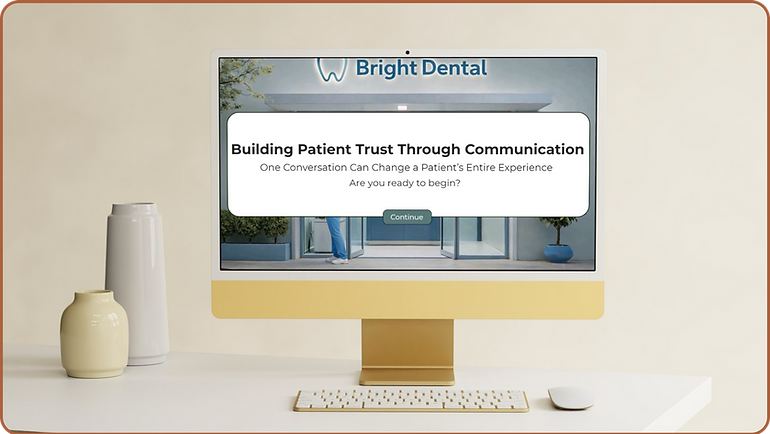
This scenario-based eLearning project addresses real-world challenges dental offices face every day. Through immersive storytelling and realistic patient interactions, it helps new dental assistants build empathy while improving patient satisfaction. It aims to reduce negative Google reviews, increase patient return rates, and
help dental assistants make every patient feel heard.
%20(4)%201%20(1).png)
OVERVIEW
1
The Audience
-
Newly hired
-
Early-career dental assistants
2
Responsibilities
-
Instructional design
-
Action mapping
-
Scenario based learning design
-
Storyboarding
-
Visual design planning
-
Interactive protoype development
3
Tools
-
Articulate Storyline 360
-
Camtasia
-
Figma
-
Adobe Photoshop
-
Adobe Firefly
-
Canva
-
OpenArt AI
-
HeyGen
THE PROBLEM
The issue wasn't a knowledge gap. It was a communication gap. Dr. Asa Carson, owner of Bright Dental, noticed an increase in negative Google reviews from patients who felt their concerns were not acknowledged during appointments. Many of these reviews pointed to communication issues between patients and dental assistants, particularly when patients expressed anxiety or discomfort.
Conversations with dental professionals confirmed that communication—not clinical skill—was a key driver of patient dissatisfaction.
Dr. Carson wanted assistants to build stronger communication and empathy skills before interacting with
real patients but lacked a way for them to practice these conversations in a safe environment and experience the consequences of their decisions.
THE SOLUTION
To address this challenge, I designed a scenario-based eLearning experience where dental assistants practice realistic patient conversations through interactive decision-making. Because effective patient communication depends on how assistants respond in the moment, learners need opportunities to actively apply these skills not just learn about them.
In this experience, learners progress through three patient scenarios based on common patient personas, each reflecting real challenges in a dental office. As they make decisions, they immediately see how their responses influence patient trust, comfort, and the overall experience.
This approach provides a safe environment for learners to build empathy and experience realistic consequences before working with real patients.
To measure impact, I tracked outcomes including patient satisfaction, empathy growth, and a reduction in negative reviews.
Scenario 1: Anxious Patient, Carol Johnson

Scenario 2: Talkative Patient, Russell Crowe

Scenario 3: Skeptical Patient, Erica Miller

MY PROCESS
Research & Insights
I collaborated with dental professionals to understand the communication challenges dental assistants face. These insights helped ground the scenarios in realistic patient interactions.
Design Approach
I used action mapping and storyboarding to focus on real-world behavior change. Scenario content was based on authentic dental office conversations, allowing learners to practice meaningful decision-making.
Testing & Validation
Before full rollout, the experience was reviewed and tested with dental teams to ensure it reflected real-world situations and would be effective in practice.
Evaluation
To evaluate effectiveness, I identified key metrics including patient satisfaction, empathy development, and a reduction in negative reviews.
ACTION MAP
I worked with a practicing dentist and experienced dental assistants (SMEs) to identify the key behaviors that drive positive patient experiences. These insights came directly from conversations with dental professionals, grounding the project in real-world challenges.
Using action mapping, we focused on what assistants need to do during interactions, such as acknowledging patient concerns and responding with empathy rather than simply presenting information.
This approach ensured the learning experience targets observable behaviors and performance, rather than just knowledge recall.

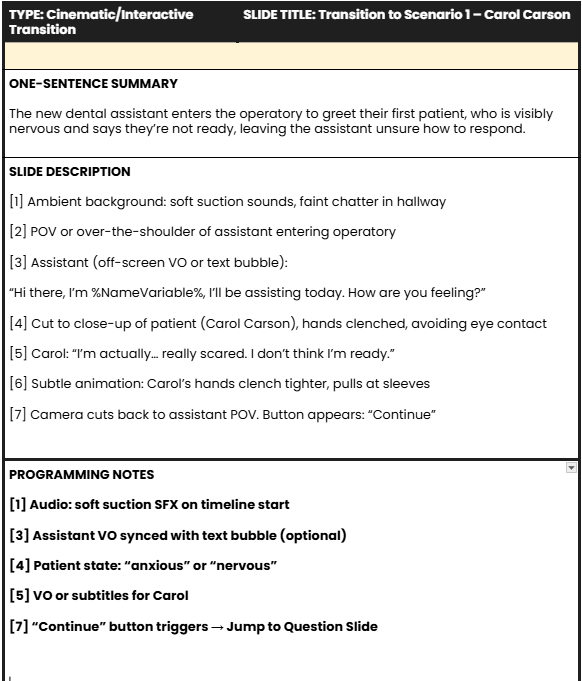
TEXT-BASED STORYBOARD
Before development, I created a detailed storyboard as the blueprint for the experience. Learners step into the role of a newly hired dental assistant navigating patient interactions throughout the workday. Each scenario includes branching decisions and consequences that show how communication choices impact patient trust and satisfaction.
To support learners, I introduced a mentor character that provides optional, just-in-time guidance during key moments, helping learners make informed decisions without interrupting the flow of the experience.
The storyboard was also structured using Gagné’s Nine Events of Instruction to capture attention, guide learners through decisions, and reinforce learning through targeted feedback.
Creating the storyboard early allowed me to map the full learner journey, reduce rework, and ensure a cohesive, decision-driven experience aligned with the project’s behavior-focused goals.

VISUAL MOCKUPS
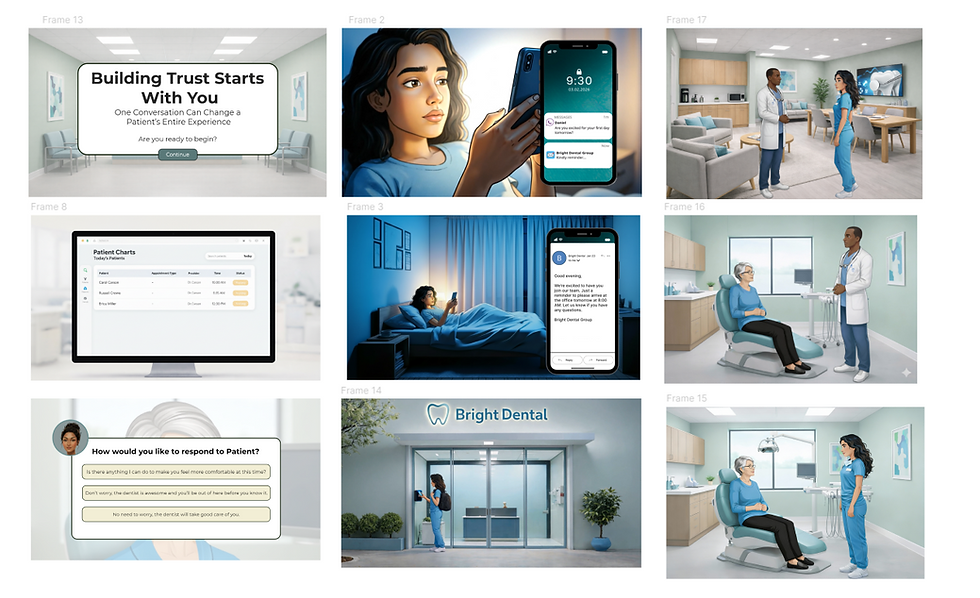
I developed wireframes and high-fidelity mockups to define layouts for each slide type before development.
These mockups ensured that key information, dialogue, and decision points were clearly presented, allowing learners to focus on making decisions without unnecessary visual distractions. To maintain a consistent visual direction, I created a moodboard and style guide defining colors, typography, and UI elements that support a calm, professional dental environment.
Designing visuals ahead of development streamlined the build process, ensured consistency, and allowed me to focus on creating a clear, intuitive interface that supports learner focus and reduces cognitive load.

INTERACTIVE PROTOTYPE
I developed an interactive prototype in Articulate Storyline 360 to test functionality and gather feedback early in the process. The prototype included:
-
Introduction and setup
-
Patient chart interaction
-
Mentor guidance feature
-
First scenario-based decision
This allowed stakeholders to evaluate navigation, usability, and overall flow before full development. Feedback from this phase helped refine interaction flow, clarify instructions, and improve the placement of key decision points.
Gathering feedback early helped identify usability issues, minimize costly revisions, and improve the learner experience before full development. During this phase, I applied Mayer’s Multimedia Principles by reducing unnecessary text, aligning visuals with dialogue, and directing learner attention to key decisions.


FULL DEVELOPMENT
After incorporating feedback, I developed the full experience in Articulate Storyline 360. The final product includes:
-
Three branching patient scenarios
-
Decision-based outcomes that impact patient trust and experience
-
Optional mentor guidance for just-in-time support
-
Interactions that simulate real-world dental office workflows
These features work together to create an immersive, decision-driven experience that allows learners to practice communication skills in realistic contexts.
Throughout development, I continued applying Mayer’s Multimedia Principles, particularly coherence and signaling, to reduce cognitive load and keep learners focused on key decisions.
.png)
RESULT & TAKEAWAYS
While this is a concept project, the design was validated through conversations with Dr. Carson and other dental professionals who reviewed the project. Their feedback confirmed that the patient scenarios and communication challenges reflect real workplace situations, indicating that the learning design is grounded in authentic practice.
Dental professionals noted that a training experience like this addresses a genuine gap, where communication skills are often learned on the job rather than practiced in a safe environment first.
If implemented, success could be measured through pre- and post-training confidence surveys, a reduction
in communication-related patient complaints, and observation of patient interactions during onboarding.
This project reinforced a core principle I carry into every design: behavior change requires practice, not just information. By centering the experience on realistic decisions and consequences, learners leave with a skill they’ve actively used—not just a concept they’ve heard about.